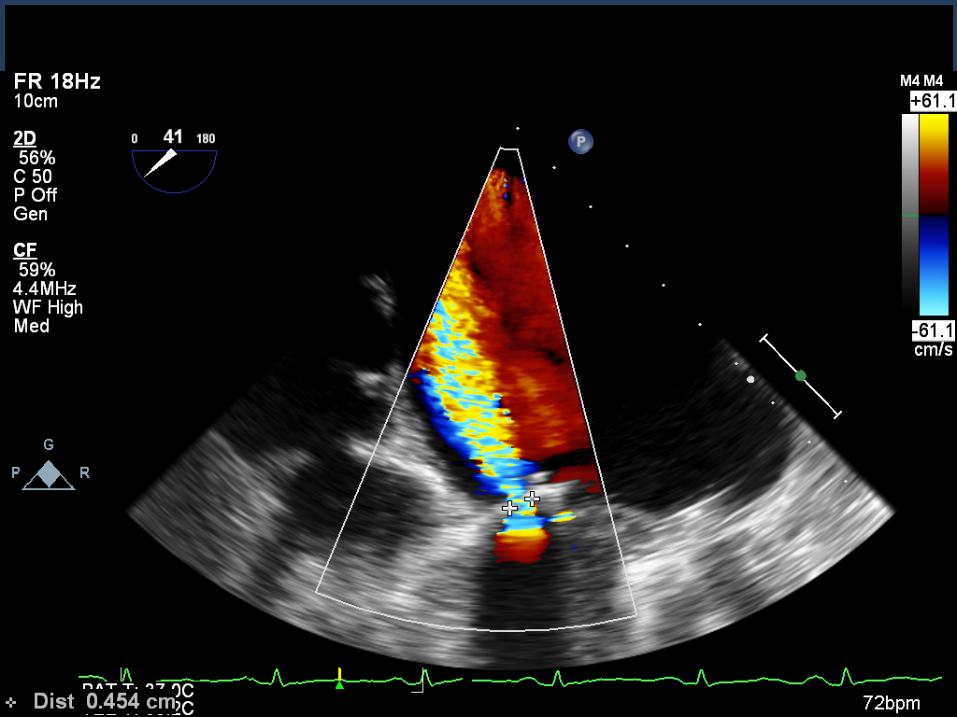
Paravalvular Leakage Device Closure Of Aortic Leak Asean Heart Journal
Start Now paravalvular leakage world-class content delivery. Pay-free subscription on our media source. Get captivated by in a huge library of documentaries showcased in Ultra-HD, suited for premium viewing geeks. With recent uploads, you’ll always stay in the loop. Browse paravalvular leakage selected streaming in photorealistic detail for a totally unforgettable journey. Link up with our network today to enjoy VIP high-quality content with 100% free, no strings attached. Be happy with constant refreshments and venture into a collection of exclusive user-generated videos crafted for top-tier media aficionados. Don't pass up distinctive content—save it to your device instantly! Indulge in the finest paravalvular leakage specialized creator content with sharp focus and curated lists.
Paravalvular leak closure is a nonsurgical treatment to repair heart valve leaks that occur after valve replacement Paravalvular leak (pvl) remains a frequent complication of transcatheter aortic valve replacement (tavr) Interventional cardiologists use pvl to safely repair leaks instead of repeating surgery, which can pose a higher risk to some people with heart disease
Device Closure of Aortic Paravalvular Leak – ASEAN Heart Journal
This minimally invasive technique provides faster recovery and smaller incisions. A paravalvular leak, paravalvular leakage or paravalvular regurgitation are an abnormal flow between the valvular annulus and the prosthetic heart valve and is a common complication after valvular replacement surgery due to inadequate sealing Paravalvular leak is a mechanical problem and so the only definitive treatment is to fix it
Patients with signs and symptoms of heart failure may need diuretics.
Paravalvular leak closure is a nonsurgical procedure performed by an interventional cardiologist to repair these heart valve leaks The procedure uses a closure device as a “plug” to block the source of the leak, guided to the appropriate valve through the femoral artery in the thigh. Paravalvular prosthetic regurgitation is a potentially serious condition resulting from degeneration of annular tissue, affecting 6% to 15% of surgically implanted prosthetic valves and annuloplasty rings